


One hour ten with the author
Pascal N. Paquette in conversation with Line Bolduc.
Speaker, trainer and author. A joyful and profound exchange on what it means to keep your light on when everything seems to be falling apart.
How do we keep our light on when everything collapses
It is around this central question that Line Bolduc invited Pascal N. Paquette to share the essence of his book.
In this exchange they explore inner resilience, self-awareness, the strength to stay centred even when everything wavers, and what it truly means to become a Lighthouse, for oneself and for others.
“No matter what happened to us, it does not determine who we are.”
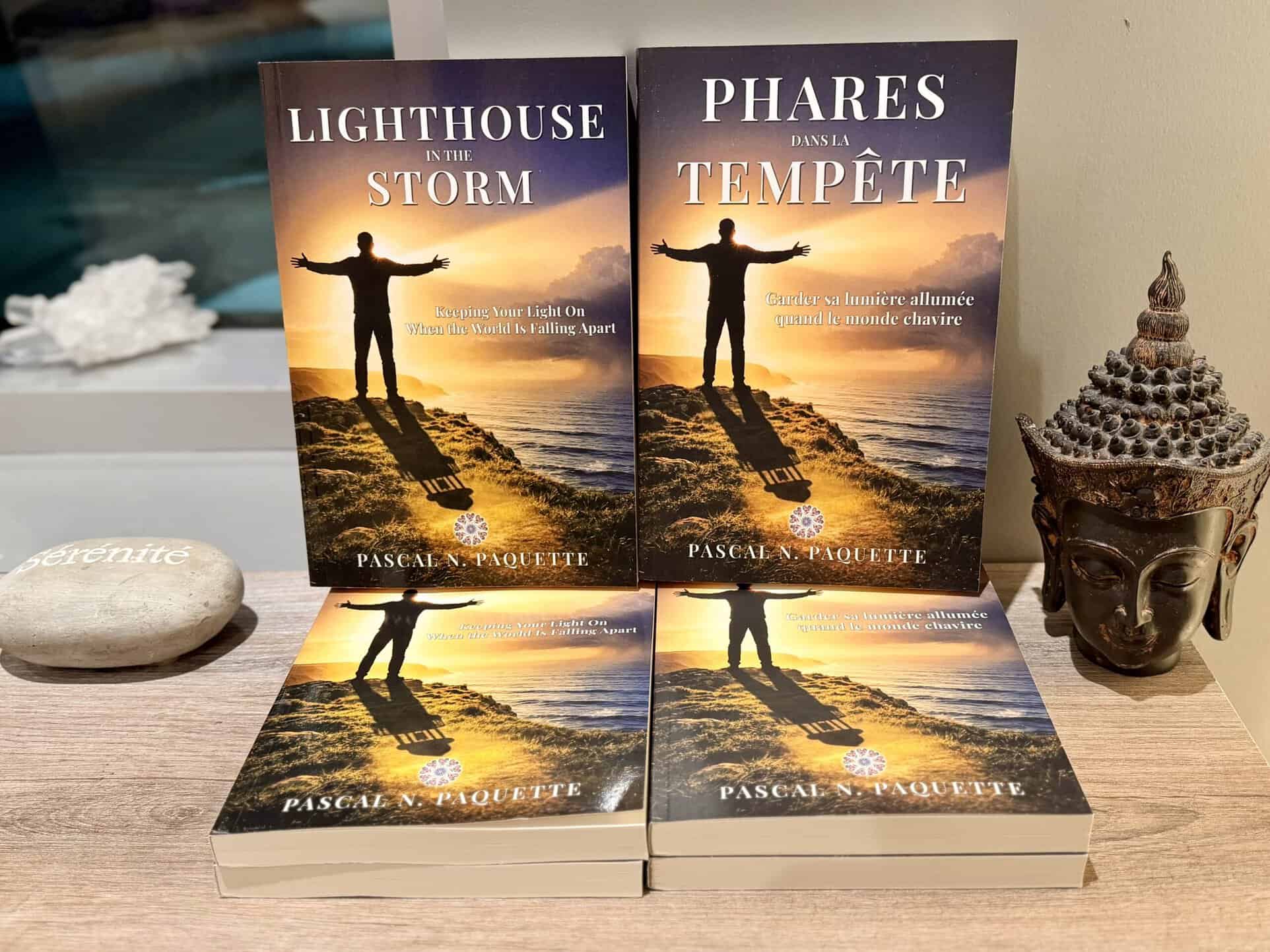
Phares dans la Tempête
Keeping your light burning when the world tips over. Sixteen chapters that form a complete path, from understanding the outer chaos to steadying your own inner light.
Become a Lighthouse, for yourself and for others
What Pascal speaks of in this conversation is worked on concretely, in session as much as in the book.
Discover the bookOr book a session, ou réservez fifteen minutes, free of charge.
Read the full written translation
This is a written English translation of a conversation originally held in French (March 4, 2026).
Line : It's a pleasure today to share with you a privileged moment with my friend Pascal Paquette. But first, we have a lot to tell. My name is Line Bolduc, I've been a speaker, trainer, and author for about thirty years, just like Pascal, who has such a long path. We're quite young. We still have a few decades of experience behind us.
And today, my aim is to speak with him because, beyond the book that has just come out, called Lighthouse in the Storm, with the subtitle Keeping Your Light On When the World Is Falling Apart, which I want to present to you, I also want to explore who Pascal is behind this man who has so much professional experience, who was for years in more private accompaniment too, all that, he'll be able to tell you about it.
But how did we meet? In 2013, I receive a message, and you've seen behind him his brand Parlecoeur. So it expresses itself well in his practice. Pascal contacts me for a professional collaboration. And from there, we gave a few conferences together, meditation evenings and all that, and life took us into other trajectories. We went and experimented differently. And recently, with the release of his book, Pascal gets back in touch with me, and no need to tell you that there, the creativity machine started up again! So, Pascal, thank you for being here with us today. It's truly a pleasure to welcome you. So I'll really give you the floor.
Pascal : Thank you, Line.
Line : To tell us a little about yourself, your path, and what led to this book too. And I know I'm giving you several questions at once, but also, what inspired the extraordinary cover? So I'll let you unfold the paths of your inspiration.
Pascal : Yes, yes, it's true. It reminds me too, when you do the introduction and you speak of the conferences we gave together. I remember too our tour in the Gaspé.
Line : Yes, yes.
Pascal : That was really, really pleasant. Truly a beautiful moment.
Line : On the edge of the shore in Percé, and we're going to create others.
Pascal : Yes. And we have a path, as we'd spoken about, very similar. We follow each other in a way; even when you were reading the book, you recognized things where you said, that's true. We have very, very great similarities. So, to answer the question of where I come from, it would be long if I really answered that, we'd speak only of that, but let's go simply. In fact, for me, what's important, as the name says: Parlecoeur, it's truly everything that passes through the heart. Whether speaking with the heart or through the heart. Those are two ways of saying it.
Everything I do, absolutely everything, is oriented in that direction: the individual meetings I have with people, the trainings, the conferences, the workshops, and more recently, the writing of books. So how did it begin? I've been writing quietly for a very long time, but never really officially published for Parlecoeur. I have one publication, but with the European University Editions, which has nothing to do with the work we'll speak of today. But still, I've already published in the past; it was an academic work. I enjoyed writing, but I wanted to write something with more meaning, deeper. So, to touch people and to help too, of course, in moments of transition. I was in the middle of writing a novel called The Bracelet of the Desert, that's its provisional title that I submitted to Le Dauphin Blanc, I think I told you about it, so I'm waiting. And at a certain point, events succeeded one another at the international level, and it led me to interrupt the writing of the novel entirely, and to throw myself into writing the book Lighthouse in the Storm, which I find, it was, how to say, when I was swept up by the energy, I can't put it any other way than that. I think the best way to say it, the words say what they say. It wasn't my choice, but it chose me, truly. That's how it is, I can say it, it happened in a flash. It just happened. There. I have it, I didn't choose it, it chose me, and I truly delivered it, let it pass through. So it's a book that's so important, so important with everything happening right now, even, as of today, but globally, globally, truly on the planet.
I find it truly important not only to look at what's wrong, but to look at what we can do within it and how we can act. Because there's so, so much feeling of powerlessness that comes from all these events we look at, sometimes from a distance, that we see on TV or hear on the radio or see, no matter, in the news feeds, and it touches us, it shakes us. I think no one can really be indifferent to it. So there are several ways to react to it, and one of my ways of reacting, at least, is by writing. And there. I'll write, and I'll try to give a more luminous side to all of it. By the way, as you were saying, the cover, I'll take it up here. So we see a being who's facing the sun, for example, we see them from behind, and there's the light toward the torso, toward the sun. But what I find interesting, and this is truly the work, to be quite frank, of the designer. I gave the idea, but it's he who created it. So he put, it's so good, the shadow of the being is a Lighthouse. And, as he said, it comes with the Flower of Life here that Cindy Daoust created several years ago. So it's like the logo I use, which is the emanation truly of the frequency of the Soul. That's how this Flower of Life was created. So it's unique. It's not something repeated. It's unique to me, for that one. So each person has their Flower of Life. So that's mine, in evolution. So all that is gathered on the image, on the cover page. And then for me, it truly symbolizes staying solid, anchored, planted on the earth, conscious, open, luminous, radiant, and stable. There, it's the image of the Lighthouse, I think.
Line : It's really well explained, and it's so representative too of what is asked of us, I think, in our inner sovereignty, which we could explore, because I feel like we should still share some broad lines with people about what message you brought through all of it. And you, who are a great explorer too, because the aim isn't to speak of politics, that's elsewhere. But you've had the chance to work across many continents, many countries, to explore. So your global vision of humanity, it's still anchored too, without comparing yourself to anyone, but in something you went to see in the field, how peoples live, you put a lot into your practice too, this energy of consciousness, and you were able, in your travels too, to look at humanity with the eyes of the heart, to go see the beautiful through the chaos, sometimes. In short, you have a teaching too that is very, very vast, on which there are foundations that are yours, that stand out and that are deep and deeply felt. So, we don't get up one morning, I think, saying I'm going to write a book or whatever. It can be the case too, but often, being an author myself, it's a life impulse. It's a Soul impulse, as you say, we're seized by that momentum, and that's what you truly translate, a great deal, to bring each person who'll take the time to go meet themselves through your book, to recognize themselves in all their light. So that's why, from the outset, I find that our role, as you say so well, isn't to seek to control the waves, but to maintain a frequency that's in harmony. And it's a language we hear more and more, sometimes that's perhaps less obvious for certain people, when we speak of vibratory frequencies, of having high vibrations. So I'd like to let you go to situate people in relation to all this momentum of harmony that you bring them to have through the book, to recognize all this light that helps them surf the waves and not control them.
Pascal : Yes, and that leads me to say, I'm able to take more complex words just as I'm able to take simple words. And here, I really wanted to make it accessible, to make it simple, accessible to all. That's truly the aim I gave myself too in Lighthouse in the Storm.
Line : It's airy? Easy to read?
Pascal : Yes.
Line : Well divided like that throughout the book.
Pascal : Yes, I'll allow myself to say at the same time, I even translated it into English. For those who prefer to speak English, because I'm bilingual, so there, Lighthouse in the Storm, and it's the same book in English and a little more, a little fewer pages in English, because generally it's more condensed. So it's a book very easy to read, 232 pages, very accessible. There are exercises too inside, we can speak about that again, but there.
So, to come back to your question, it's the question of frequencies, and how to stay stable. I love very simple metaphors. They allow one to understand things, they make them accessible when we're in something a little more philosophical or a little more technical; the metaphor brings things back to where everyone understands. So, for example, it's, I don't know, minus 10, minus 15, minus 20 degrees Celsius outside. And suddenly, we want to go outside, we're in the house, it's nice, we're at 20 degrees. And we want to go outside. It's cold, of course. And we want to keep our warmth. It's a little like keeping our frequency. Here, we want to keep our warmth, we want to keep our temperature. So what are we going to do? We're not going to go outside without a coat or without a hat or without mittens. We're going to dress accordingly, and we're going to go outside. Now, no matter the quality of the coat we have, there's a certain limit to what we can tolerate and how many hours we can stay outside before beginning to feel the cold. So there, there are two things we can do, either go inside, like going inside oneself, finding one's inner space again, so finding one's frequency again, warming up, to then go back outside, why not, after, that's life. That's what we do. We go into life, we meet people, we live situations, or else we stay outside, but we put ourselves in motion, we can get active, we can move, run in place, or do some sport, and we generate warmth. And again there, at a certain point, we still need to go back inside, to recharge our batteries, to rebuild our strength, to nourish ourselves. That's an image. And that's it, maintaining one's frequency, no matter the temperature here, maintaining one's inner warmth, no matter the temperature. We're not going to let ourselves freeze suddenly, physically, because outside it's cold. So we're going to choose, well yes, our electromagnetic field, our coat that keeps our bubble of warmth around us, and it has its limit. We must come back inside and rebuild our strength.
A little, I love too the image of technology. We take a telephone device, a phone of some kind, we use it. The battery drains, and at a certain point, we want to recharge it. So we plug it into the source, electricity, and suddenly, we find our charge again. And so, that way, we can use it constantly. If we've talked eight hours straight on the phone, of course the battery probably won't hold out, it won't hold eight hours. So why, why not, and here I push a little, but why not leave the phone plugged into the source permanently? Why not? Why exhaust the battery? Why get into energy-saving mode? Why stress, live the anxiety, the fear that suddenly our phone stops working? So we're going to keep it plugged into the source as much as possible to keep its battery well charged. And if we really must unplug for one reason or another, we must go outside or whatever, well, then we have a battery that's well charged that will give us energy for a good while. So that's a little the metaphor I use to keep one's frequency, to keep one's light on. And obviously, if it's 20, 22, 23, 24 degrees outside, I don't need to take as much care of my bubble of warmth because the outside isn't disturbing in relation to that, it's in harmony with me. But if it isn't, whether it's too hot or too cool, I must adjust to keep my well-being. Does that make sense?
Line : It's so well said, the simplest, most fluid and comprehensible explanations I've been able to hear, truly. You bring each person, in the end, to stay in the eye of the cyclone, no matter, cyclone is a big word, but no matter what's happening around us, by staying connected to the source, to our higher intelligence, no matter how we'll call it according to each one's beliefs. Well, we're no longer in a spirit of sacrifice either, wanting to submit to everything asked of us, everything we thought we had to do or be in order not to displease, and so on. We have these concepts too, that when we learn to dissociate from them, that is, being centered in the eye of the tornado, no matter, in the storm, there we stay at the center. Well, we stay connected much more easily without draining our energy. It's a little all of that I hear behind it too. And it brings us to stay anchored in self-love, in consciousness, no matter what happens.
Pascal : Exactly. If I remember, I was perhaps 20 years old or something like that. I was reading a book, I never found it again, I already did. I probably didn't keep it, it was called Solitude Facing the Sea. I almost, I almost spoke of it in the book Lighthouse in the Storm, Solitude Facing the Sea, and at a certain point, the author spoke of, she was in Percé, she was facing the sea. She was taking a moment of contemplation, and she was realizing that the only space that isn't in motion, for example, if we take a bicycle wheel or a wheel, any car wheel, it's the hub at the center, the axle, the hub, and as long as we stay at the center and don't let ourselves be carried away by the movement that turns like that, we're not stretched toward the edges. As long as we stay at the center, life can roll at whatever speed it wants. There's no problem. We stay in the only aspect that's stable on the bicycle wheel, which is at the center. If for one reason or another, we're suddenly swept toward the outside, well, what happens? We have to really stop. We have to stop the bicycle, stop the wheel, to be able to come back toward the center. And the little image, that perhaps only the people who already knew La Ronde long ago, the rides, La Ronde, if ever there are Europeans listening to us, "but what's he talking about?" I'll explain it a little, because there was the Rotor.
Line : I remember that. I wasn't much for rides, myself, but we know La Ronde, I did a little of it in activities at certain festivals in Quebec, and I didn't make a career of it!
Pascal : No! So what's interesting is that the Rotor is something that begins to turn, and turn, and turn, and it sticks us to the sides. It's the inverse image to what I gave a little, but it sticks us to the sides, and they can even remove the floor and we stay stuck to the walls. And as long as it turns, we can't come back toward the center. It's impossible. And we have to stop. And that's interesting. The metaphor, if I push it a little, is that as long as we stay centered, things go well. And when we let ourselves get off-center, and it's not serious, really, it's not serious. It's normal, I'd say, it's part of life. At a certain point, there's something that sweeps us up, something that throws us off-center, that disharmonizes us or whatever, well, there we take the time to find ourselves again. We take the time to go meditate, breathe, contemplate, everything that allows us to come back to the center. And once we've found our center again, well, there. We can meet life again. What's to be avoided is to stay off-center and try to continue with the events. That's never interesting as a result.
Line : Really well said. And sometimes, often, a little phrase I've often asked myself, and it'll happen to me again: is there joy, ease, lightness in what I am, in what I do? Am I in harmony with my needs, with my values? It can seem hard, but what are my non-negotiable territories, in other words, that, if we take the couple relationship, I'm making a little parenthesis, but, and you want, in a couple, what do you really need? So in intimacy, in communication, spiritually and all that, when we're in agreement with those values, we stay at the center much more easily, because we know ourselves better, we're more anchored. So I find that makes a parallel a little with what you say too. And if we look a little further in your book, when you speak at a certain point of the fact that we're not broken inside, fundamentally, even if sometimes we have the perception that it was the case, we lived abuses, traumas, there are all sorts of life stories, but we're more like veiled, in other words, our light is already present, but it's waiting for us to remove layers, and to avoid seeing that as work, but rather as a rebirth to oneself, because yes, we have programmings, fears, beliefs, and often we've identified with all that. But there's a phrase you bring that, for me, resonates so much. It's a philosophy of life connected to the fact that we're not broken, but that the light is always there. To remember who we are.
Pascal : Yes, to remember who we are. Yes, absolutely. And that's, I'll take the word "work" here. It's often the work of a lifetime, or of several years. It's not something where we say, there, I remember who I am, because otherwise it stays as words. We can well hear someone else say, here is who I am. It stays as words, but it's about feeling it, integrating it deeply. And I often like to say that no matter what happened to us, no matter what happened to us, it doesn't determine who we are. And that's so important. I find, to grasp and understand that. It's, no matter the past we had, the abuses we suffered, the culture or the events that created our personality, like it or not, that creates our personality, and not who we are. So, to take the best image, to go in the direction of your question, it's, but who are we really, who are we really? How can we know who I am? That's the great question that's really not easy to answer. So I'll go rather with a metaphor, once again, rather than losing myself in explanations. So when we think of it, imagine everyone, everyone knows what it is, either when we've been parents or we've held a little baby in our hands, or we've seen, in any case, a little baby in our lives. Those little babies, when they arrive there, naturally, we look at them and we love them and we find them beautiful. And we're like, wow, what a beautiful light! It's natural. Nearly all human beings, unless really, really veiled, will have that feeling looking at the newborn. And I often amuse myself by saying: it does zero performance there. It speaks no language. It has no diploma. It's true. It's totally dependent on everyone. In short, it's of no use to society. I say this with a wink, we follow each other! It has no usefulness as such. It responds to no norm. And there. And yet we love it totally and unconditionally. And that's the best way to say it, that's where we're closest to what we really are. It's before all the layers, all the conditionings. And all those layers, all those conditionings, like onion peels. And I speak of it a little in the book, we must remove them one by one, one by one. And that's it, when I say the work of a lifetime, sometimes, one by one, one by one, until finding again the heart of who we are at the center of all that. And that's well beyond everything we can imagine, think, believe about ourselves, our roles, what we do, what we live. And I say, well, I'm a parent, I'm a coach, I'm a speaker. I am... so we create an identity like that, which is fine, we need that too to function in society, but not to believe in it as if it were ourselves. And that's it, all the work of finding again the essence, the light of who we are. I remember, it reminds me of when we gave conferences together, you often spoke of the prism, right?
Line : Ah yes, I remember.
Pascal : You remember that. There.
Line : In Percé, among other places, unforgettable.
Pascal : Yes, yes, and the prism. It's so that. It's that kind of inner jewel that receives the light and rediffuses it in multiple colors. So there, essentially, how I can say it without going into the details, without losing ourselves in technicalities, truly, it's finding again that purity of the child in us before all those layers. And earlier you spoke of joy. If you'll allow me, I'll continue, because that's how I am, my momentum. You spoke of joy. And when we look at a child playing, they don't play, they don't think about what they're doing. They play, they're in joy, they're in spontaneity, they assemble things. They disassemble things, they move things around. They simply play. They don't reflect. And later, at a certain point, we begin to reflect, which is part of life and it's fine. And when we begin to reflect, but to reflect too much, that's when suddenly we lose sight a little of that joyful, spontaneous, alive, and lively child. And that's what we want to find again. That's what's to be found again within oneself.
Line : I find that right now, we need that. It's easy, sometimes, to say, we're going to go untie things from the past, and that can lead to digging into the past, even if we're conscious that we have layers to remove. But in the present moment, we also need to contemplate everything that's beautiful, toward what we want to go individually and as a society. And I find it's those aspects that you open too, to avoid staying in a character we've identified with from the past, in order to create new chapters of life through all of it too. And when you spoke of the prism, I'll just make a little parenthesis to put people in context, because often, in conferences, I bring diamonds, which are very symbolic, even if the object is tiny. And when I give them to people, I ask them to see this little prism as their inner diamond. It becomes an anchor, a symbol of all our radiance, that we're not what we believed about ourselves because we were told and all that, we come out of that and we come back to the center, precisely. And then there's, an anecdote really happened with a lady when we were in Percé together, I remember the broad lines, but I'd given two diamonds to people so they'd give one to another person. And to pass it on, as we say, and we'd come back, I think, another time, after, in any case, there was the lady who'd told me, this diamond, she went and brought it to someone who was at the end of life. It had been like a flash of light that made it spring forth. It was so beautiful. It was so touching. It was a little more detailed than that, but in short, it shows how, when we're in that space of the heart, so many beautiful things happen, and we set off a different magnetism too, a nervous system that's more soothed, and it becomes the creator of a reality that will be much more in harmony and aligned with what we want to be and become, by that very fact.
Pascal : Absolutely.
Line : So, you speak a lot of anchoring, of not defining oneself by the storm, it's a little what you've just translated, and when you give the example that we can set off to drive 2,000 kilometers with a full tank, well, it's a little the same thing when you spoke of the phone earlier, to avoid being in the utopia that our energy is inexhaustible and that we can scatter ourselves and all that. We're not here to feel guilty, but our energy is precious. And this connection, well, to maintain it is to avoid going off on an adventure, taking everything as it comes, without asking ourselves questions.
Pascal : Yes. And that's precisely, I speak of it in the book. It's something I think no one would really dare say, "I'm going to fill my gas tank and I'm going to drive 2,000 kilometers." We can be, certain vehicles can do it, but in any case, not mine, so generally, what is it, 600, 800 kilometers maximum that a vehicle can do in the best circumstances with a full tank. So what we want to do, when we see the little needle going down at a certain point, we say, we're going to stop and we're going to go fill up before the light comes on, before the needle reaches "E" in the red, and before the engine shuts off on the road like that, because there it's complicated, it takes a tow truck and going back, putting in gas, and so on. So, with a little wisdom, we look at our gas gauge, and we're going to stop, quite simply. We're going to take an exit off the highway, for example, and we're going to go put in gas. And after we continue, and that way, we stay calm and at peace, we don't have to live with a stress. Imagine the stress it creates to live, to drive, and to be on the road with a tank where we never know when it's going to run dry, but truly dry. So that creates an anxiety, often, and that anxiety is something I often see in people in general, it's something so, so common nowadays, the anxiety of something we know we should do, but that we haven't yet acted on, and the simple action could already greatly diminish that stress. That's one element. And after, the other element is the element where we've forgotten what we were supposed to do. And we have the anxiety but we don't even remember the source anymore. We don't remember it, we just lost it, but we know that something, and that's even worse, because there we tell ourselves, but what do I have to do to arrive and find that peace? That's what nearly everyone seeks, that state of peace we seek, that we tell ourselves we always push back to later... when I'll be retired, when I'll have money, when I'll have completed my studies, when the children leave the house, when I've paid off the mortgage, because it's always in the future. But it never arrives. I'm sorry. I hope I'm not bursting too many balloons right now in saying this, it doesn't arrive, it's that the state of peace is something we touch now. It's not something that's going to arrive later, after having responded to a series of social elements that lead us toward something, right?
Line : So much. And as you speak too in the book, you allude to Jacques Salomé, how he speaks of relational terrorism, but how we do violence to ourselves too by going against what we know. And we don't judge ourselves at all in that. We all sometimes have challenges, positioning ourselves in action and all that. But sometimes having it repeated to us, hearing it again from another angle and all that, it sometimes opens additional aspects, and you truly bring it too, how important it is to come back to this benevolence, this non-violence toward oneself too. And so I'll let you tell us a story.
Pascal : Yes, of course. Of course, I'll perhaps tell it a little differently from the book. It's not serious. I'll let you discover the real story.
Line : The mother and her daughter!
Pascal : The mother and her daughter, the father and his son, the mother, no matter. It's a situation I see so often. It's, for example, a mother who'd like her child to sit up straight at the table, not use electronic devices, and be present with the others while eating, and use their utensil appropriately to feed themselves. And that's her intention. And what she wants, deep down, is what? It's for people to be in contact, in harmony, for us to speak to each other, to look at each other during the meal, and for us to be well. And there, it's an intention of harmony, of joy, of peace, of contact, we can imagine that. It's very beautiful. It's very, very noble. And there, suddenly, imagine the little girl who refuses to conform to what the mother asks, and rather than taking, and often it's little banal things that trigger it, rather than taking, I don't know, her fork as she should, she takes her spoon, or she refuses to sit up straight, or she says no to something. And there, the mother bursts out, gets angry, takes her by the arm, pulls her, and tells her, you're going to your room, and alas, really in a very, very severe way. And that's it, imagine an adult at the height we have. I do it like this. We're, we're tall, we're intimidating for a child, a child, it's so small. And that child sees us as tall, sees us as big, and on top of that, adults have an energy that's strong, and we arrive and we have this kind of, that's why I call it, and Jacques Salomé called it relational terrorism. It's like it terrorizes the child who, suddenly, is afraid. And there, if we do that repeatedly, one day, we just come into the room to, I don't know, tidy the child's room, and the child has a movement of recoil like that, of protection. It becomes that they're afraid of their parent. There's not a single parent on earth who wants that. I hope, in any case. And a parent doesn't want that; what they want is contact with their child, and they want it to go well at the table when we eat together, you see. And so why use a method like that? So there are two main reasons. The first is that it works. Unfortunately, terrorism works. Relational terrorism will give the result we want. So the child will sit up straight, will take their fork out of fear of being terrorized again and of being reprimanded or being, at the limit, made violent toward, physically or with words, or with an energy, a look. The child wants to please, wants to be loved. So they'll conform, except that in doing this, although we have the desired result, what we destroy is the relationship. What we truly destroy is the relationship of trust. The relationship where the child must be able to feel protected by their parent and not intimidated by them. So yes, and I see this so often, family dynamics like that where the parents find themselves having an intention that's truly noble, we don't doubt that at all, but the means gives what they want, but not totally, because they don't want only the result. They want to keep the relationship. And then, I remember so well, I have plenty of examples, but I bring them up like that without personalizing them to anyone. They're people who realize, reaching a certain age, the children are grown, and realize suddenly what they did or didn't do, or how they did it. And there, it's a little too late, it's the past. The children are 20, 30 years old, and realize... Ah no... I reproduced what happened to me. And that's it, that's what happens, it's that we take the tools we have. If we give only a hammer to screw in a screw and I have nothing else, I'm going to take the hammer and I'm going to strike the screw. Unfortunately, I'm going to destroy the thread. I'm going to destroy plenty of things. So it's perhaps not the right tool. And that's why the importance, and that's the advantage we have in 2026, it's that tools, there are some, there are so many now, it's accessible. You, you yourself produce them, Line, tools to equip people, and they have an incredible toolbox. I see all the books behind you. Each book is a tool. Each chapter, each word, each... and it's so important, and you give people tools. And that's what's important, tools precisely so that, to say what I want and what I'm trying to get at, perhaps the method of relational terrorism isn't the right one. Perhaps I should look at other ways of doing it. And that's what we want to create, that opening of consciousness and that self-reflection, that self-observation. And after, to go seek different tools that will bring us to the total result, that is, the child sits up straight, speaks with us, takes their fork, and we keep the relationship, and the trust is there. There.
Line : Really, thank you for your kind words too. Yes, it's a passion. We meet through that. I have seven books written too. That makes for shared inspirations over time, but it's the climate of trust we create with the child. If I give the example, my children were little, and every evening, I'd come to put them to bed, I'd ask them, were there any little clouds today? So it allowed them to verbalize what had been less pleasant while staying alert as a parent too. And I always finished by saying, what did you like most today? So that's what we always have as a choice. What do I create as an energy of communication? But it's as if we haven't always had the tools. So when we become aware of it, it's to continue going as well as possible toward oneself, and toward others, of course, we could speak of it for a long time. And when you speak of violence, it's, when we go back in time, you mention it in the book too, we had films, for example, either on TV or even at the cinema. It was for 13 years and up only. But we look today, the littlest ones have access to nearly everything on the internet. It's no longer filtered. So this violence that's too present makes us desensitize ourselves at a certain point, it becomes almost something normalized. I'd like you to speak to us a little about how you bring it in the book at that level, because we need a little, like the example of the frog that doesn't feel the heat because we raise the temperature slowly. We need to come back to that presence too, to realize with what we let ourselves be absorbed, as information, as solicitation, as our language too, sometimes, which can be hard toward oneself, as we've just mentioned. So there's a whole concept at that social level that's to be reviewed in order to stay a luminous Lighthouse.
Pascal : Yes. And that, we, I don't know if you see it in my face, but we're entering a zone where it can really be slippery. So I'll be careful. I'll put on my skates. I'll try to skate well. It's really a slippery zone because, I'll explain why. It's that we can't say it's because of all the violence we have access to that that's what creates violence. That would be to deresponsibilize ourselves totally and to put it on the back of the films or the violence in films or video games or whatever. Because it's not true that all those who have access to those tools, no matter those distractions, it's mostly in the world of distraction, who will necessarily be violent. It has nothing to do with it. There are people who are very gentle, who choose good words, who are extremely pacifist, and who use it really simply as an exciting game with a little adrenaline. But for them, they know very well it's not reality. They won't confuse the two. That's why I say it's a slippery terrain. And there are certain studies that say no, there's no connection between the violence we see in games and the effect on children. So we're really in a slippery terrain.
So what I'll say is rather what I observe. Okay, what I observe is this kind of desensitization. How, how did I say it in a book, always seeking anesthesia, anesthesia, speaking of the...
Line : The frog. That's where I wanted to go, really, yes. There, desensitization, it's the frog in the water, and we raise the temperature slowly, it ends up cooking. So...
Pascal : Without ever, that's it.
Line : Without ever realizing it, that's it.
Pascal : Yes, there, without ever realizing it. We see more and more of it. The first time, it strikes; the second time, we say, well, it's a repetition; and the third time, we let it go. And that's when, suddenly, there's a kind of disinterest, and there's a kind of, we truly acclimate to our environment, and we become insensitive, and we tolerate more and more certain things. And I'll take as an example, we see this. A fight happens in a schoolyard with children, and people will film it and put it on Instagram or Snapchat. And it becomes a way of seeking likes rather than intervening and putting an end to what's happening, which makes no sense. So it's not only an anesthesia, not only tolerating the heat that rises more and more without reacting, but on top of that, there's a benefit that comes with it. That's even worse, I think, I didn't address it directly in the book, but there's a benefit, certainly, that comes with it. And that benefit is the element here that has to evolve and transform. That'll be for the continuation of the book. That's in the second one I'm in the middle of writing. But let's stay in the first. It's truly the frog, we heat it and it doesn't realize the water is heating. So it develops a form of tolerance, of acclimation, we acclimate a little. We breathe air there. Someone who smokes, it's the best example I can take, the first time we take a cigarette, for those who have smoked, everyone chokes, I don't know anyone who takes the smoke into their lungs and who isn't going to choke, the first cigarette. But the second, already it's better, the third, and eventually, we smoke a pack of cigarettes, two packs of cigarettes a day, and we no longer cough. We tolerate, our lungs come to tolerate. Yet, is it good for the health? I think no one can say it's good for the health to smoke. There's a tolerance that settles in. There's a tolerance to the chemical elements we breathe in the air, the pollution, more and more. And yet it's not good. So it's the same thing here. There's this kind of violence that's more and more tolerated, accepted. It happens in films, so it's fine that I'm like that at school, I see it in films, and in video games. So it's normal that I'm like that with my friends. It's, that's how it comes to normalize it, and that's where the role of parents, and I call them Lighthouse parents too, who will come, yes, who will come offer this so-important nuance to the child. This is a game. This is a film. It's not reality. It's not how we behave. This is staged, as we say. And here, these are sensitive humans like you. It's bringing it back to that. It's so important, and to find again that sensitivity. Now, it's true that the more we find our sensitivity again, the more we're disturbed by everything that surrounds us. And that's a little the trap. It's how to continue living sensitive in a society, in an environment where it's not going down, it's going up, this violence. And I speak at the global, planetary level. Truly.
Line : It brings us back to the hub, as you were saying earlier. Once again, the importance of staying centered, and of having a perception that's defined by the meaning we give to our life, that makes the bridge to when you speak of the example of the five people in front of the chocolate cake, there's a parallel. You've perhaps already heard too the example of the blind men in front of an elephant, and they each have a part of the elephant to touch, and one thinks it's a pipe for the trunk, and the other a fence post for a leg. But they each have a perception that's different. But in the example of the chocolate cake, I find it interesting, I can't give away all the punches of the book, but at the same time, it's as many individuals as there are perceptions. But what are my perceptions versus what is, because we say a child is like a sponge on which the parents imprint. So there are conflicts of loyalty often that will make us reproduce the model we lived in our family aspect. But when we arrive at the situation of the chocolate cake, well, who's right? Not right? Because there are many social divisions we'll see on all sorts of subjects. So I'll let you take us a little where you'd like.
Pascal : And I'm going to build, as we say, on the chocolate cake. Jacques Salomé spoke to us a lot about why cut a cake into identical portions. Why don't we cut a big piece, a little piece, a medium piece, because there are as many individuals as there are tastes and desires. So one person feels like having a bigger one, the other a smaller one, their appetite smaller. So that's one element. So another element is, in front of the chocolate cake, someone who's already, I don't know, been sick eating chocolate cake will look at the cake and they'll have a disgust, and for the other, chocolate reminds them of their grandma when they were little who made them chocolate cakes. And so it's a food that's like reassuring, soothing, whereas for the other, it's disgust. It's the same cake, but different reactions. And so each person will have a different perception of the same element. And none of them is right, and none of them is wrong. And that's what's fascinating, it's that a perception belongs to us.
Line : Yes.
Pascal : And I'll even add another example, I think it's interesting, a personal example that happened to me when I was a child. Like any child, we go play outside in, let's say, winter, and I'd frozen my hands. I'd really frozen my hands. You know, when it hurts there at the fingertips, when it thaws, and I'd come inside and I'd told my mother, my hands are frozen, my hands are frozen, and she told me, come put your hands under the water. Come put your hands under the water. She says, that's how we soothe it. So I see her, I still remember the scene, she puts her own hands under the water, she chooses the comfortable temperature for her. And there, when I come to put my hands, it's as if it were burning water! And there, I said, no, but come on, you're burning my hands. She says, but no, it's lukewarm water. No, it's burning water. So you see, those are two perceptions that are completely different facing the temperature of the water, which is, deep down, I don't know how much, let's say 20 degrees. It's a figure. So, and that's where it's interesting. It's each perception. Two people in the same room. There's one who's cold and the other who's hot. It's fascinating. Is it hot or is it cold? It's neither hot nor cold. One person is hot and the other is cold. They're perceptions. So we can't be stubborn about a perception. We can't, it's so personal.
Line : Yes, that's it, it leads to having a vision more from above. Each person has the right to live their life as they understand it. Me too. Is it so important to, but we're different, like the fingers, but is it important to have our nose everywhere, wanting to manage the outside, the lives of others? And often, we'll see those phenomena, and it doesn't mean there's no interaction, and bonds and all that. We're conscious. To what do I give my attention? With what do I nourish myself? Can we simplify? It's a little all of that too, because it leads to drama. You speak at a certain point of the story of two people, and one, to be heard, is a lot in the drama, but in the end, her partner ends up telling her, look, that's not the approach that's going to bring me closer to you. If that attention is produced by exaggeration or tears or all that, we can understand that it's not necessarily conscious and voluntary when there were wounds behind it. But I find that you truly bring it back to self-awareness, where we have a gentle possible responsibility when we come back to this benevolence and this humility of looking, what is my story, is that a behavior that nourishes me, that illuminates me, that still does me good, to be able to go meet that. So you have a beautiful gentle way, I find, of bringing us to reconnect with ourselves, and of looking at where we can lighten and also remove layers, as we were saying earlier.
Pascal : Yes, and all the heritage we receive, because deep down, it's like a heritage. So often, I take this example, an aunt somewhere who, in dying, bequeaths us her house. It's very far. It's in the area of Rimouski compared to Montreal, for example. And suddenly, we say, yeah, but I live in Montreal, do I want a house in Rimouski? After, we go there. And there we see all sorts of things. The height of the ceilings doesn't suit us. The color of the carpet, the state of the furniture, and so on. Are we obliged to take the heritage as it was given to us? Or can we modify it? Can we remove the carpet and find the wood floor underneath and sand it and have a varnished floor? Why not! Our aunt didn't like it, but perhaps we do. So we can take the heritage we were given, we can make an extension, add a veranda, another room, put a second floor. Everything is possible. We can sell it entirely if we don't even want to live there. Yes, it's our heritage. So that's what we receive, the famous transgenerational baggage from our parents. After, we take the time to observe it, and we say, me, what do I want to keep of this? What suits me? Because there are things that are very good, and there are others that don't suit, either because it dates from a very long time ago, it's culturally outdated, or it doesn't give the result I want, like, for example, relational terrorism or whatever. So we can change, and that's what I'd say. Yes, if someone is waiting for the authorization and the right to change something, well, go ahead! It's not to betray your family lineage to change an element!
Line : Really, yes.
Pascal : This element of loyalty is so strong in people. It's, well no, it was like that at my place, so I have no choice but to do the same. But no, but no, but no, we betray no one. On the contrary, we free ourselves. Yes.
Line : Because otherwise we fall into self-sabotage of happiness, like in a family, someone, the whole family wouldn't have the money to go on a trip, but one person who works to be able to realize that dream because it's important for them, and they go, often, we'll see people live mishaps on a trip. As if, if I have too much happiness, I wouldn't be aligned with my family. So I'll be able to come back saying, my trip went badly. So we diminish the happiness in that case, it's a little all of that, the conflict of loyalty too, that we can sometimes have. And it brings us, as you say in the book too, to distinguish which voice within is speaking. Is it the voice of the mind, of those patterns? Or is it the voice of our inner guidance.
Pascal : Hmm. And that's it. It's the work of a lifetime. As I say earlier, it's the work of a lifetime to arrive first to hear. First, and after, to know how to catalog, to distinguish. What belongs to what, what comes from where? What speaks to me within? So I look at the chocolate cake. We're going to take up the chocolate cake again. It's very good! So we're going to take up the chocolate cake again. Very good in every sense of the word. And then there's a voice that says, go, go, eat it, it's not serious. Go, well, yes, you work tomorrow, it's true that it's 10 at night. It's time to go to bed, but eat your chocolate cake...! It's not serious! Go! You hear it, I hear you laughing, it's funny, everyone has this voice within them, and there, the voice of wisdom that appears at the same time, or at least, a few minutes before or after, that says, but no. You know very well that you sleep badly when you have chocolate, cocoa, sugar, and so on. Wait until tomorrow. Wait until tomorrow...! The other voice says, but no, why wait?! Now! It's fine, take it right away! And the other voice says, but no, you're going to bed. You know very well it would be better to wait until tomorrow. So, it's like, okay, who am I, am I this voice or that one, or...? At the center, with these two voices speaking to me. And that, I take a light example, but sometimes that, it's an easy, light subject. You know, a child is constantly in that conflict with their parent who loves them, is benevolent. So no, 8 at night you're going to bed, no chocolate cake, and the child, they want it now. So we're going to tell them, yes, you'll have one tomorrow at 3 when you come back from school, we'll even eat one together. So we'll make a beautiful moment of it. So we try to postpone. But for that, the parent is conscious that the child has that voice of whim, at the limit, we could say, they want it right away, immediately. And the parent makes themselves the voice of wisdom, generally, makes themselves the voice of wisdom, and the child makes themselves the voice of whim. So it's all that play, I take it very simply, but we can go so much more complex and so much deeper.
Line : So much, because it's, in, we made for ourselves, without realizing it sometimes, like our heart, we'd made a fortress around it in order not to suffer, a kind of emotional protection, but it led us sometimes, unknown to us, to a kind of interdependence with suffering. When we can have an interdependence with what's positive, it's a little like an athlete who's going to train, as you say, and doesn't arrive at their gold medal at the Olympics by snapping their fingers, there was repetition. There was commitment to oneself. So we've often been in our inner character, I find, in this interdependence with models, but it's up to us to deconstruct all that in order to shine in our most luminous essence, yes, but the simplest, natural, authentic too, instead of being in that armor we have the choice to fracture.
Pascal : Absolutely, and to make choices, precisely, you say it, to choose. And here, it's the choice. And I bring a little nuance. I think I didn't speak of it in the book. In fact, I don't remember everything I said. That's how it is after we've written a book.
Line : We don't reread ourselves all the time.
Pascal : No, that's it. And it's the nuance between will and decision. A will, very often, it's, for example, someone who says, I'd like to meditate every day. So the person wants to. They come, they're going to do a training. They want to integrate a discipline, yoga or whatever, they want to train. They want to go take a walk outside, they want, they want, no matter what they want. And that will, it's very often unstable, a little like the weather at times, it's stronger at times, it's weaker, it's very, very, very unstable. So we can't rely on the will to initiate a real change. So the will, it's too often failing. It lacks stability, it lacks constancy. The decision, it. That's the, I have to put a big word in our meeting, the word discipline. Oh, there, plenty of people are going to say, no, me, it's over. I don't want to know anything.
Line : I'm going to support you, because we say, yes, it's Stanton University, I don't remember in which city anymore, Boston? I'm not certain. But I'd seen this research, 92% of New Year's resolutions, for example, don't work. Why? They're taken on the will and not on this luminous discipline. There can be gentleness in that discipline, having plenty of love, instead of seeing it with the mind, and the big mountain, no! It's the gentleness we offer ourselves.
Pascal : Gentleness without complacency. There, gentleness without complacency. It's interesting to find that middle we seek so much, to move away from the extremes and find that middle we seek so much. And it's in that middle, in that zone, it's a zone within oneself where everything is in harmony, everything is, everything is at peace. And often, I take the example of a guitar of very high quality, but with strings that are badly tuned. It's going to sound bad. We won't be able to play and create a harmony, whereas we can take a guitar of lesser quality, but with new strings well tuned, and so on. And it can sound very, very good. It's important. It's a set of elements. It's truly a set of elements that creates that harmony, like in a choir. When we hear a choral song with dozens or hundreds of singers, and suddenly there's a wave that harmonizes. We get chills, we feel it, we hear it, it's wow. And sometimes we can touch that. It can be a fraction of a second, but it changes everything, it changes everything. And after, we know what we're seeking in life. It's toward that we want to tend. And that's where the decision, the orientation, the loving discipline, all in gentleness, without complacency, brings us toward that.
And I'll take an example. Someone who decides to go train. And they train every day in a rigorous way, and very proud of themselves, they succeed, and so on. And one day, their body hosts a bacteria or a virus or whatever, a life circumstance that makes it so that, if they went to train, it would still be discipline, but it would be more gentleness and love, because there they'd just weaken themselves instead of fortifying themselves. When they need, it's to stay home, calm, without training, and it's to arrive at having those nuances within oneself, well negotiated with the whole of all those voices, as we spoke of the voices, to find, and once the body is well healed. And there, the bad habit of staying in bed has been taken, it's to find the loving discipline again to say, yes, I'm going back to training. And the will isn't strong enough for that. It takes the decision.
Line : Yes, and joy, it's finding what can give us joy, seeing the advantages too that are there, instead of seeing the constraint that the mind has recorded too. So it's truly to retame our way of being in relationship with ourselves in that. And then when we speak of our thoughts, precisely, Pascal, you compare at a certain point, the sky is not the clouds, the clouds are not the sky. Our thoughts are not us. If there's a thought of devaluation, "I'm so worthless," or whatever, we are not that, when we spoke of disidentification!
Pascal : Disidentification!
Line : Disidentification!
Pascal : Disidentification!
Line : Disidentification!, that's something I bring a lot in conferences, I think we do it well too, keeping joy, the spontaneity, the right to make mistakes out there, perfectionism that's so demanding. So, you and I could arrive at a conference, and we make a mistake in our words, do we carry our material any less for all that? No! So I love it when it happens to me live, because I take you as an example, it's funny!!
Pascal : Yes, it happens to me often too.
Line : So it's indulgence toward oneself. Yes, really important. And that's why I was going to say it's important to disidentify! from our thoughts, like the sky and the clouds are not the same entity.
Pascal : It's interesting, because, indeed, we are the sky, we are not the weather, I think, and it's one of the elements I speak of, that's it, and that, we bring it a little further when I teach the training in meditation, and even when I guide it or whatever, I always say, let the emotions, or the thoughts, the emotions flow like a river that flows without obstacle. And the thoughts, they're like clouds passing in the sky, that the wind carries away without our having to chase them or hold them. We have nothing to do, we let them go. When we're children, I'm sure you've already lived that, we lie down in the grass and we look at the sky and we look at the clouds, and there it circulates. And there, we see a sheep, an elephant, all sorts of figures, all sorts of things. And we don't run after the elephant, we don't run after the sheep. We don't run after the lion, we let it go. And there's another that appears, another that appears, and we laugh, and we find it funny. And it's arriving at having that detachment. The thoughts pass, sometimes there's a cloud a little darker. Sometimes it's a cloud a little whiter. Sometimes it's colored thanks to the sunset or whatever, they're only clouds... and I push the metaphor a little. Nearly everyone has taken a plane one day, has taken a flight. And when we take off and, for example, it's raining, it's cloudy, it's stormy, the plane takes off, and as soon as we arrive, as soon as we've crossed the layer of clouds, and the sun that's there permanently, the clouds are only below, and it's only over a small portion. It's not over the whole planet. And they have nothing to do with the rest of the universe. So, as soon as we rise above the layer of clouds, suddenly, we find the eternal day, the infinite sun that, no matter how we call it, the clouds exist only below.
Line : Yes.
Pascal : To keep that consciousness.
Line : Yes, exactly as you say, I feel, I let it pass. And I keep my energy to create what I want. It doesn't mean at all that everything is perfect in life, and in that day, but we give ourselves the right to go meet our sensitivity, our vulnerability. You know, I've worked a lot, and it's still the case, but in professional settings, in companies, congresses, and all that. And we'll see sometimes that the professional suit becomes like an inner prison where, because we're in a role to do our tasks and all that, it's as if we'd want to set the human aside. But no matter in which sphere of life, to authorize oneself to go meet our emotions, for certain people, it's not easy. If there was more injustice, sometimes, betrayal, things that came to make it more hermetic, but it's part of it, I find, when you mention letting it pass, being an observer of the situation, to say, okay, yes, I lived those closings, but does it still serve me to be afraid of speaking of my emotions and all that? It's to tame oneself, sometimes, in a new relational mode in relation to oneself. I find that experiences come to teach us all that too.
Pascal : And yes, I always say, life is a spiritual gymnasium. It's our, it's our gymnasium, it's all of that. We don't have, it's not just inside a building. It's truly life. And it's arriving at integrating, precisely, our daily life in that life, and using it like a gym, realizing that each experience is truly an occasion to evolve, to learn, or to express oneself. It's not always to evolve, but sometimes, it's just to express oneself, to be creative. So each occasion, we can use it. There's never an occasion, there's never a situation that's banal, everything has a meaning, and we can truly use them in that sense.
Line : Yes, because our life experiences, I take the example of my career, it passed through a story of collapse, of sexual abuse in adolescence and all that, of, I didn't know if I'd get through it, and from there, well, we go seek help, authorizing ourselves too to be helped. Because, you mention in the book at a certain point, the less we let ourselves be helped, it's as if, unconsciously, we push others away, because if no one, you know, it's a game of mutual aid too in society, we love to give, we'll ask in conferences sometimes, do you like to give more or to receive, and the majority of people will say to give, but we need to receive. Me, I was that person who didn't want to receive. I'm the strong woman, I'll manage on my own. I collapsed. So it became the springboard of my career at that moment. That's why for each person, your life is a work of art. I find, and when we recognize that we do a little of that assessment, not to say, okay, I'm reaching the end of my life, I make an observation, no, it's, what are the strengths, the successes I've achieved, on which I can lean too, instead of seeing the little flaws we might have had, and our challenges. They're there, it's a reality, but our life story can be a springboard of rebirth. And I think that's the invitation you bring through this magnificent book called Lighthouse in the Storm.
Pascal : Lighthouse in the...
Line : Storm. Each person goes and draws on this innate essence of life, and makes a strength of it so the clouds can pass more easily and look at them in a sense of observers and not as an identification.
Pascal : Absolutely, exactly that.
Line : You spoke of plateaus. I think going there a little, we approach a little what I felt like sharing with you, but I'll let you go if you have other inspirations that come to you, but sometimes, we'll live plateaus in a life. And there, there are people who are there, we spoke of violence toward oneself sometimes, how is it that I'm not yet further, there, it becomes, it's more of a process, progressive, obviously, a process, it's progressive, it resembles, but it becomes relentlessness. So we're no longer in an energy, a fluid manifestation at that moment, and normally, sometimes, it can happen that something is longer. I'd like, it's a little like our carrots that we can't pull on so they grow faster. So, like a pianist or an Olympic athlete who practices a long time to arrive at excellence. Well...
Pascal : Yes.
Line : Our plateaus. How. Yes.
Pascal : There are really two angles, the angle you bring, and it's a really interesting one. I think, in any case, that it's not quite how I bring it in the book, but it's two ways of seeing the plateau. The plateau of saying, okay, are we being relentless about something. Indeed, at a certain point, it's as if we reach a level of success, or at least of transformation. And we may well force, in quotation marks, and it no longer transforms. Is that true?
Line : Yes. Because you bring it more in the axis of keeping the confidence to...
Pascal : Yes, to pass to the next. Yes, that's it.
Line : And not being in relentlessness.
Pascal : That's it. So, for example, when we look, I don't know, at ice that's frozen at minus 30 degrees and we heat the environment up to minus 10 degrees. In appearance, there's nothing that has transformed. We still have ice. We know, so we tell ourselves, but, but there, if it's a plateau, I may well force, I may well heat. It gives nothing. I can't manage to transform it into liquid. It's a little the angle you brought. So that's indeed, and that, yes, it's something we see often, and continue to heat a little more without being relentless, but in the consciousness that the ice is going to melt and it's going to become liquid at zero degrees, and continue to heat more, it's going to become a lake or a comfortable pool to bathe in, and continue to heat more, one day, all that is going to evaporate. So it's the transmutation or the change of state here that we're speaking of. I brought it from another angle that's a little complementary, because it's a little the same plateau, but seen from another angle, it's the angle of saying. Someone who says, okay me, I've reached a comfortable level and I'm stopping there. That too, it happens, we see it often. It's like, well, I've reached my comfortable level. And there, my evolution is done. It's over. I have nothing more to do. It's a trap. It's a trap. And the very gentle image I take in relation to that is, when we want to go from the first floor to the second floor or the third, no matter, we climb stairs. And when we arrive at the top of the stairs, well, we've reached the second. We no longer need the stairs, but we're not at the eighth yet. We're at the second. So we want to continue walking on the second. We see this sometimes in shopping centers, they put an escalator. And after that, you have to cross the store to take the other escalator. So it's knowing that there's always a step to continue, that's one element.
Line : Yes.
Pascal : And to, yes, we don't want to stop at the plateau. It's not the end, on the contrary. And like a very high-level athlete who trains, at a certain point, they continue to train, but they no longer see, in appearance, in any case, progression. They must continue to persist, not be relentless, persist in the discipline, like, for example, the best example I can take, when I began to meditate, it took a year before I touched the state, just the fraction of a second of the meditative state. It's long. A year before reaching that. So, and when it happened, it disappeared almost instantly, and it took another six months before it came back. So it's my coaches, at the time, of meditation, they told me, continue. Twice 20 minutes a day. It was Transcendental Meditation that I began with. Continue, persist, continue, don't stop, and one day you'll see, all that is going to happen. So that's the plateau too, from another angle.
Line : Yes, that's it. As you mention in the book, things are in the middle of rooting themselves, and the roots always grow before the branches.
Pascal : And of course, so we sow a seed. And then we look, we're not going to dig it up constantly to see if it's germinating, we trust the process and we know there will be a tree.
Line : Absolutely, and I think the last element I wanted to address with you, which sums up a lot of the whole of your book, when you speak of elevation, in other words, it's the recognition of who we are. If we look for big terms sometimes, big principles and all that, it's in that simplicity, when we come back to that light, what are we? What do we want? I'll let you express it in your own words. I think there are so many things that simplify themselves, that harmonize from there, the elevation happens by plunging within, by descending.
Pascal : Yes. And that, it's the beautiful paradox. It's elevation by plunging within. It's truly the paradox, because the more we plunge deeply, the more we find the entire universe. It's the paradox, once again, and it's daring, daring to stay in that inner space long enough, like when we take a bath, for example, to relax, if we stay two minutes and we come out, we haven't reached the level of relaxation that the good hot bath can offer us. To stay a little longer, until the soothing, and until finding that kind of decontraction that arrives at a certain point and that brings us to find that state of expansion and elevation. Of course, that gives a sensation of elevation. Me, I call it expansion, elevation, no matter the words. And that's it, we find it when we stay in that presence to oneself long enough to arrive at it.
Line : So much. Thank you, Pascal, for this privileged moment. I invite each person to share this interview. I don't even call it an interview, it's a conversation. It's an energy of the heart offered for the greatest good of everyone. So if people want to get this beautiful treasure, what's the best way, Pascal?
Pascal : In fact, to go to my website Parlecoeur.com, in the books section, there's Lighthouse in the Storm, and there will be others. So there.
Line : People can subscribe to your newsletter too?
Pascal : Subscribe to the newsletter, yes. I feel like adding perhaps a little thing in closing, since you open the door to me. It's a little of a punch at the end of the book. Yes and no, in fact, it's that there's a place, it's written, Join the community of Lighthouses, and that, on my site, there's also a place, yes, where people can really, yes, that's it. It's when we recognize ourselves, after having read the book or whatever, we recognize ourselves as Lighthouses for ourselves and for others. We feel like, sometimes, finding ourselves together and sharing a moment, having tools, having resources, and that, I invite people, by going always to the page on my site, in the books section, there's the place where we can really get the book, but there's also the place where we can join the community of Lighthouses. So when you've reached that page in the book, I truly invite you to come join the community of Lighthouses. And then there. Together, we create more light.
Line : Well yes, it's truly a beautiful creation. And at the end of the book too, you have a section that invites people, deep down, to have a Lighthouse commitment toward themselves, with different points of reference in that sense, it's really well done. And then a whole section of exercises too, according to each of the chapters, and we see it at the end, indeed, it's mentioned, join the community of Lighthouses. So page 186, if you already have the book in hand. So it's a little jewel. I truly invite you to give yourself this gift, to bring love, gentleness, benevolence within, and this beautiful connection to your center, what we need most. On that, I'll let you have the last word...
Pascal : Well, the last word, it's going to be, thank you Line. Thank you, Line, for this invitation, for this beautiful sharing. And as you say, it's not an interview, it's a sharing between us, so natural and spontaneous. I love it. Thank you. Thank you for being here.
Line : A pleasure, thank you. Bye bye everyone.